



For more than half a century, the Algonquin College Radio Broadcasting Program wasn’t just a place to learn; it was a life force. It was a community, a boot camp, and a launchpad that has rocketed thousands of voices soaring across Canada and beyond. CKDJ 107.9 FM and AIR AM 1700 are more than just radio stations; they are proof that video never killed the radio stars—it only made them stronger. The program built a legacy that now, at its close, feels impossible to measure.
As the final class of Algonquin Radio prepares to sign off—a result of the college’s decision to suspend the program [1], [2]—the community it created is grappling with an indescribable sense of loss. But this moment isn’t just about the closure of a chapter; it’s about celebrating an incredible, multi-generational story. It’s a time to honour the dedication of the professors, the tireless work of the students, and the local musicians and artists showcased by the program. It is also a time to celebrate the powerful, enduring sounds of CKDJ 107.9 FM and AIR AM 1700, the campus stations that trained a generation of broadcasters. The program may be ending, but its impact will be eternal.
More Than a Classroom: Finding Purpose and Building Community
For many, coming to Algonquin wasn’t just enrolling in a course; it was finding their professional identity—a pivot that changed their entire trajectory. It created an intense environment where shared passion forged a close-knit extended family.
The Pivot: Finding Professional Identity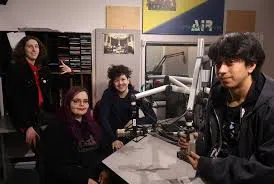
Bob Perreault (Class of 2000) perfectly summed up this life-changing clarity: “The Radio Broadcasting program at Algonquin means the world to me. It changed my life.” (Alumni Testimony) He recalled that, at 25, he “had little direction.” He credited the program for his long career, adding, “Here we are a quarter century later, and I’m still doing it and loving it. And that is thanks to the radio program.”
Joel Scott (Class of 1995) echoed this sense of finding purpose, calling the program a “gift.” “At the time I got the program, I didn’t really know what I wanted to do with my life,” he shared. He continued, “When I got into the radio program, it was immediately clear in the first week. The program led me on a journey for 22 years that I carry to this day.” (Alumni Testimony)
Even those who weren’t sure what they wanted found their footing instantly. Maddy Eisenberg (Class of 2016) admitted she “basically tried radio on a whim” but quickly realized the program was a perfect fit. She thanked it for “being the change that I needed in my life at that moment.” (Alumni Testimony)
The Unbreakable Bonds
The intensity of the program—with its late nights, tight deadlines, and shared love for radio—forged bonds that often outlasted careers.
Hannah Toth (Class of 2021) found it was a place where she could meet others who shared her interests. She credits the program with shaping “my friendships that have made lifelong ones.” (Alumni Testimony)
Perhaps the most touching example of this connection comes from one of the faculty members herself. Lana Paine (Class of 1997 and Professor) shared her ultimate takeaway: “I met so many great friends during my time in the program… But I also met my husband. Yes, Simon Paine and I have been married now for over 25 years.” (Alumni Testimony) It’s a reminder that this was truly a space where personal and professional lives intersected to create something special.
The Training Ground: Passion Meets Production
Algonquin Radio wasn’t built on lectures; it was built on real-world application. Students weren’t just learning about radio; they were running two actual radio stations—CKDJ 107.9 FM and AIR AM 1700—from day one.
The Adrenaline of the Airwaves
The atmosphere in the studios of the N-Building was electric. As Alec Miske recalled, his favourite memory was simply “showing up to the station every day.” (Alumni Testimony) He added, “There was so much creativity… It always inspired you to reach farther, kind of, and try harder, and to do more.”
The adrenaline of that first moment on air is a common thread among graduates. Dayna Brez (Class of 2014) perfectly captured the rush of the mic: “That feeling, that adrenaline was like nothing else.” (Alumni Testimony)
The curriculum was a demanding mix of technical and artistic skills, from mastering sound editing to developing a confident on-air persona. Roberto Da Silva credits the performance classes for transforming him from a “huge mumble mouther” into someone who could speak with clear “enunciation.” (Alumni Testimony)
The Mentors Who Believed
Behind the success of every student was an army of professors—true industry veterans. These mentors didn’t just teach the curriculum; they offered personal mentorship that often made the difference between quitting and succeeding.
- Roberto Da Silva openly thanked Professor Don Crockford for saving his career. (Alumni Testimony) After a tough critique left him ready to walk away, Crockford “saw me, sat me down and talked to me about staying in the program because he believed that I had a future.” (Alumni Testimony) Da Silva noted, “And here I am 20 years later, still in radio.”
- J.C. Coutts (Class of 2003) fondly remembered Professor Ian Barry for his clear and consistent advice on performance: “the knowledge, the advice on how to improve your on-air performance, all of it I still remember crystal clear to this day.” (Alumni Testimony)
Where Radio Took Them: A Nation of Sound
The ultimate payoff of the Algonquin experience is the vast array of careers it launched. The skills learned weren’t limited to traditional radio; they were fundamental to any audio or communication-based field, opening up opportunities across media, film, and television.
Decades in the Industry and Across the Map
For many, the program guaranteed a professional life in the industry they loved:
- Mike Irving (Class of ’76) built a staggering “43-year career in radio broadcasting.” (Alumni Testimony)
- Kris McCusker (Class of ’94) proudly noted her “30-plus year career in broadcasting” with stops at major stations in Toronto (like 680 NEWS RADIO) and Ottawa. (Alumni Testimony)
- “Stuntman Stu Schwartz and Consuelo Bernardi found a home right here in the
Capital, with Stu getting hired “the day after graduation.” (Alumni Testimony)
The program taught them to be ready for anything, including a career that spanned the map. J.C. Coutts used radio as a passport: “It was so cool to have a career that started in Ottawa, took me to Timmins, then off to Peterborough, then Wingham… and then eventually to Yellowknife in the Northwest Territories.” (Alumni Testimony)
From Radio to the Emmys
Simon Paine (Class of 1997) used his audio training to transition into film, working as a production sound mixer on shows like Survivor and The Amazing Race. His career trajectory led to multiple Emmy Award nominations—a powerful example of the program’s rock-solid foundation for any audio professional. (Alumni Testimony)
Meanwhile, Daouda Doumbia (Class of 2020) used the program’s creative energy to embrace entrepreneurship, starting his own podcast, Inside Deez Mindz, which “helped me network with other creatives in the city.” (Alumni Testimony)
Beyond the Signal: Community Impact
The Algonquin spirit was also about using the airwaves for good. Colin Teskey (Class of 2013) shared a deeply moving memory of the class using their skills for a local cause: “We decided as a group we were going to go and broadcast a kids’ hockey game in Kemptville because one of the kids’ dads was unable to make the game… he was able to listen to the game in the hospital.” (Alumni Testimony)
AIR AM’s Final Chapter: The Future is Uncertain, But Not Silent
The news of the program’s suspension—driven by institutional financial constraints—is a tragedy for Ottawa’s media scene. As an alum noted, losing the program means potentially “losing storytellers who keep the community connected.” [6]
However, the powerful heartbeat of CKDJ 107.9 FM and AIR AM 1700 won’t flatline immediately.
The station holds an active CRTC license that runs until 2030 [3]. This gives the dedicated alums and volunteers a crucial window of time to fight for the station’s survival. They hope that Algonquin College will decide to transition the station into a successful, independent, volunteer-run operation, much like the models seen at Carleton (CKCU) and the University of Ottawa (CHUO).
The path is challenging. Despite community proposals, the College’s Students’ Association (SA) has publicly stated that it has “no plans to acquire 107.9 CKDJ FM [4]” at present. The lack of an immediate institutional backer makes the long-term outlook difficult.
But you can’t deter the Radio Broadcasting community once they’ve set their minds on something. Their focus remains on maintaining the signal and its history as “Ottawa’s only all local new music station” [5]. The immediate future will be a determined scramble to secure its long-term survival.
The students are leaving, but they aren’t turning off the lights. As the alumni universally concluded: “One small studio to a nation of sound. This is CKDJ, and this is the legacy of Algonquin radio.” (Alumni Testimony)
The program is ending, but the unforgettable sounds, professional standards, and lifelong connections it forged are now scattered across the airwaves, echoing in every station and production house where an Algonquin grad is working. The legacy is secured; the final battle for the frequency has only just begun.
Sources
Alumni Testimony
- Quotes interviews with alumni containing testimonials from program graduates and faculty.
Public and Media Sources
- [1] Algonquin College. (n.d.). Operational Updates FAQs. Algonquin College website. (Referenced for program suspension and teach-out details).
- [2] Algonquin College. (n.d.). AA30 Program Suspension and Cancellation (Policy). Algonquin College website. (Referenced for program suspension details).
- [3] Ko, E. (2025, April 25). Off the air: Algonquin College radio students lament the loss of a beloved program. Algonquin Times. (Referenced for CKDJ license duration and program suspension context).
- [4] Ko, E. (2025, April 25). Off the air: Algonquin College radio students lament the loss of a beloved program. Algonquin Times. (Referenced for the Students’ Association’s position on acquiring CKDJ).
- [5] The History of Canadian Broadcasting. (n.d.). CKDJ-FM. Broadcasting History website. (Referenced for CKDJ’s historical programming focus).
- [6] Ko, E. (2025, April 25). Off the air: Algonquin College radio students lament the loss of a beloved program. Algonquin Times. (Referenced for alumni quotes regarding the program as a “game-changer” and the loss of “storytellers”).
Comments